
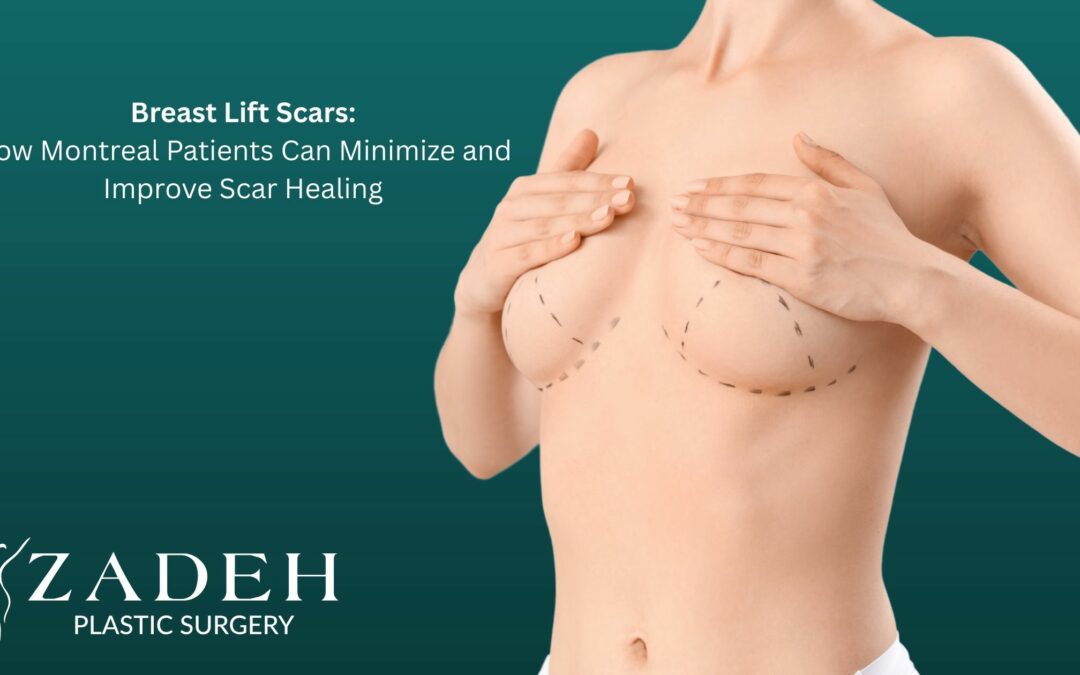
Breast Lift Scars: How Montreal Patients Can Minimize and Improve Scar Healing
For many patients considering a Breast Lift, the most common hesitation is not the procedure itself, but the concern around Breast Lift Scars. Questions about visibility, permanence, and healing are central to the decision-making process. Understanding how scars form, how they evolve, and how they can be optimized is essential to approaching Breast Lift Surgery with clarity and confidence.
In modern aesthetic surgery, scar management is no longer passive. It is a strategic, multi-phase process that begins in the operating room and continues through advanced post-operative care.
Where Are Breast Lift Scars Located?
The placement and extent of Mastopexy Scars depend on the degree of breast ptosis and the surgical technique required to restore shape and position.
Common incision patterns include:
Periareolar (Donut Lift)
A circular incision around the areola, typically for mild lifting with minimal excess skin.
Vertical (Lollipop Lift)
Around the areola and vertically down to the breast fold, offering improved reshaping with moderate lift.
Anchor (Inverted-T Lift)
Around the areola, vertically downward, and along the inframammary fold. This approach is used in more advanced cases where significant tissue repositioning is required.
“Every incision is planned with intention,” explains Dr. Teanoosh Zadeh. “Our goal is to position scars where they are naturally concealed while preserving breast contour and long-term structural integrity.”
What Do Breast Lift Scars Look Like Over Time?
The evolution of Breast Lift Scar Healing follows a predictable biological sequence known as the scar maturation process.
Inflammatory Phase (Weeks 1–3)
Scars may appear red, raised, and slightly firm as the body initiates healing.
Proliferative Phase (Weeks 3–8)
Collagen production increases, and the scar begins to stabilize, though redness may persist.
Remodeling Phase (3 Months to 1 Year+)
Collagen reorganizes and softens. Scars gradually fade, flatten, and integrate more naturally with surrounding skin.
Patients often ask, “Do breast lift scars fade?” The answer is yes, but this depends on individual healing biology and adherence to post-operative care. While Breast Lift Scars are permanent, their visibility can be significantly minimized with proper management.
How Dr. Zadeh Minimizes Breast Lift Scars Surgically
A refined surgical approach is the foundation of optimal Breast Lift Scar Healing. In Breast Lift Surgery, technique matters as much as aftercare.
Dr. Zadeh’s approach emphasizes:
- Precise incision planning aligned with natural anatomical lines
- Tension-reducing closure techniques to prevent widening of scars
- Layered suturing methods to support internal healing and reduce surface stress
- Fine-line scar technique to promote discreet scar formation
“Scar quality is largely determined at the moment of closure,” says Dr. Teanoosh Zadeh. “By minimizing tension and respecting tissue dynamics, we create the conditions for elegant healing.”
Breast Lift Scar Healing Timeline
Understanding the timeline helps set realistic expectations for patients undergoing a Breast Lift.
- Weeks 1–2: Incisions are healing; swelling and redness are expected
- Weeks 3–6: Scars begin to stabilize; early collagen formation occurs
- 3–6 Months: Scars may appear darker before gradually softening
- 6–12 Months+: Progressive fading and flattening
The full maturation of Mastopexy Scars can take up to one year or longer, depending on individual healing capacity.
How to Minimize Breast Lift Scars After Surgery
Effective Breast Lift Scar Healing requires a proactive approach during the recovery phase.
Key strategies include:
- Silicone gel or sheets
Widely supported in clinical literature for improving scar texture and reducing hypertrophic scarring - Scar massage
Enhances tissue mobility and supports collagen remodeling - Sun protection
UV exposure can darken scars and impair healing - Support garments
Reduce mechanical tension on incisions during early recovery - Smoking avoidance
Essential for optimal tissue oxygenation and healing
These measures are part of a comprehensive post-operative scar care protocol tailored to each Breast Lift Montreal patient.
Advanced Treatments to Improve Breast Lift Scars
Modern scar management extends beyond healing. Advanced regenerative treatments can significantly refine the appearance of Breast Lift Scars.
Microneedling for Breast Lift Scars
Microneedling is a collagen-induction therapy that creates controlled micro-injuries to stimulate tissue regeneration.
Benefits include:
- Improved scar texture and smoothness
- Reduction in pigmentation irregularities
- Enhanced collagen and elastin production
Fractional microneedling is particularly effective in treating mature Mastopexy Scars by promoting structured collagen remodeling.
Exosome Therapy for Scar Healing
Exosome therapy represents a cutting-edge approach in regenerative medicine.
Exosomes are signaling molecules derived from stem cells that:
- Enhance cellular repair
- Reduce inflammation
- Accelerate tissue regeneration
- Improve overall scar quality
When combined with microneedling, exosome therapy amplifies the body’s natural healing response, making it a powerful adjunct in Breast Lift Scar Healing optimization.
Who Is Prone to More Visible Scarring?
Not all patients heal the same way. Factors influencing Breast Lift Scars include:
- Genetic predisposition
- Skin type and pigmentation
- Tension on surgical closure
- Smoking or impaired circulation
- History of hypertrophic or keloid scarring
A thorough pre-operative assessment during a Breast Lift consultation helps identify these risk factors and guide individualized planning.
When to Treat Breast Lift Scars
Timing is critical when addressing Breast Lift Scar Healing.
- Early phase (first 6 weeks): Focus on protection and hydration
- Intermediate phase (6 weeks to 3 months): Introduce silicone therapy and massage
- Later phase (3 months+): Consider microneedling or exosome therapy
Intervening too early or too late can impact outcomes. A structured, physician-guided approach ensures optimal timing and results.
FAQs About Breast Lift Scars
Do breast lift scars go away?
No. Breast Lift Scars are permanent, but they typically fade significantly and become less noticeable over time.
How long does it take for breast lift scars to fade?
Most Breast Lift Scar Healing occurs within 6 to 12 months, with continued improvement beyond one year.
Can microneedling improve surgical scars?
Yes. Microneedling stimulates collagen remodeling and improves the texture and appearance of Mastopexy Scars.
What are exosomes and how do they help scars?
Exosomes are regenerative signaling molecules that enhance cellular repair and improve scar quality when used in advanced treatments.
How can I minimize scarring after a breast lift?
Follow post-operative care instructions, use silicone therapy, protect from sun exposure, and consider advanced treatments such as microneedling.
Begin Your Personalized Consultation
Choosing to undergo Breast Lift Surgery is both a physical and emotional decision. Understanding how Breast Lift Scars form and how they can be optimized allows you to move forward with confidence and clarity.
Schedule a private consultation with Dr. Zadeh to explore your candidacy, understand surgical techniques, and receive a personalized plan for optimal Breast Lift Scar Healing and long-term aesthetic outcomes.